Get the weekly hi-fi digest — new gear, best reads, and deals.

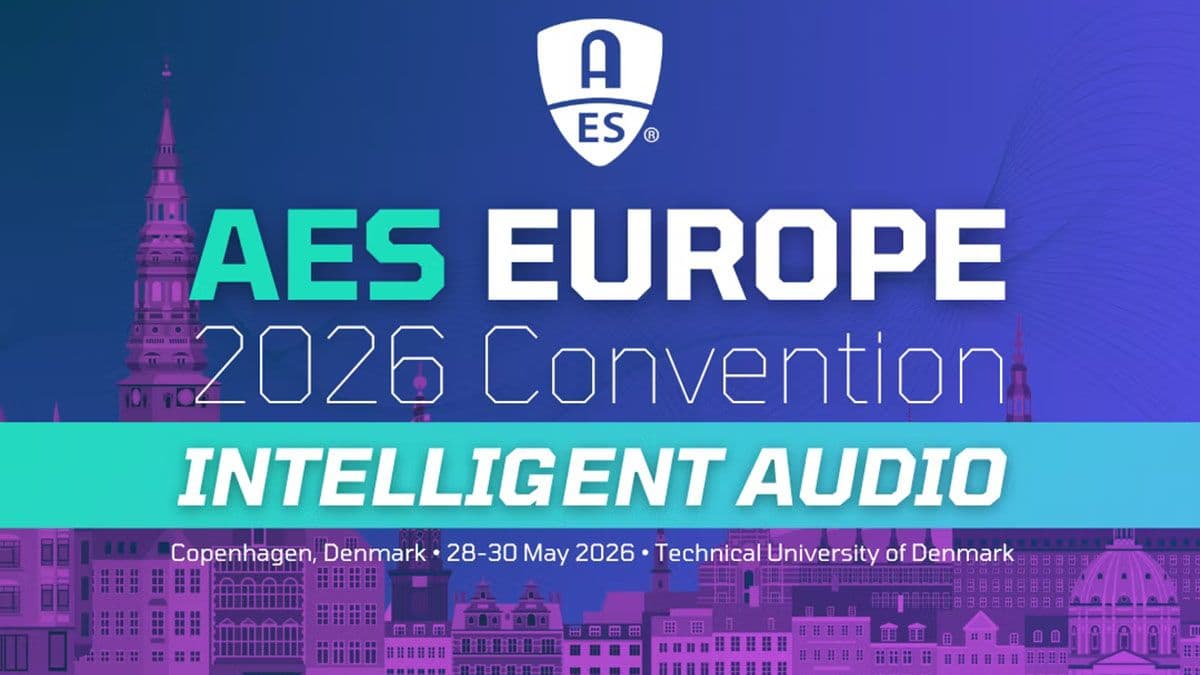
AES Europe Convention 2026 marks the 160th AES event, held May 28–30 at the Technical University of Denmark (DTU) in Copenhagen’s Lyngby campus.
The convention continues AES Europe’s tradition of high-level technical programs, focusing on immersive audio, artificial intelligence applications, and peer-reviewed research sessions.
Keynote speaker Geoff Martin, Bang & Olufsen Director Specialist for Audio Quality, presents “The Perceptual Irrelevance of Physical Measurements,” challenging conventional audio metrics.
What stands out in the Copenhagen return is the deliberate pivot toward an academically dense format rather than a trade-floor-driven one. Recent European editions demonstrated that removing a traditional exhibition shifts the center of gravity toward papers, signal-chain theory, and psychoacoustics rather than product spectacle. Hosting the convention inside a technical university reinforces that direction: sessions are likely to lean heavily on methodological rigor—listening models, statistical treatment of preference data, and the messy interface between DSP theory and human perception. For engineers used to debating FIR tap length versus phase audibility on forums, this kind of environment tends to reward careful argument over headline specs.

The philosophical tension between measurement absolutism and perceptual relevance is also shaping the technical narrative. The forthcoming discussions echo a long-running divide in hi‑fi circles: whether ultra-low distortion figures and ruler-flat responses actually correlate with perceived quality once room interaction, listener adaptation, and content variability enter the picture. Expect examples that stress how precision instruments can mislead when the metric itself is poorly aligned with auditory cognition—a topic increasingly relevant as AI-driven audio tools optimize toward loss functions that may not map cleanly to human preference. This is where data science, psychoacoustics, and classic listening theory are starting to collide.
Equally significant is the emphasis on hearing science as it intersects with consumer audio. Research trajectories that once lived in clinical acoustics—HRTF individualization, near-ear noise exposure metrics, and long-term threshold shift modeling—are now directly applicable to headphones that double as spatial renderers or assistive devices. The blurring line between earphones and hearing aids forces uncomfortable but necessary questions about calibration standards, safe SPL management, and how spatial cues should be preserved or altered in rehabilitation scenarios. For designers wrestling with binaural filters or adaptive EQ, these discussions promise insights that go far beyond lifestyle tuning and into the fundamentals of how sound is safely and meaningfully delivered to the ear.
New gear, best reads, and deals — every Friday.

* The M3 Plus ASANO TANCH Edition DAP, a collaboration between SHANLING and TANCHJIM, launches globally on February 20, limited to 2,000 units.

* Steven Wilson announced the release of his new concert album, 'Impossible Tightrope,' recorded live in Madrid.

* Knowles has introduced a new family of multi-way balanced armature drivers, designed to enhance premium TWS earbuds and in-ear monitors.

* Samsung Display introduces the Penta-Tandem technology for its QD-OLED panels, enhancing performance and durability significantly.