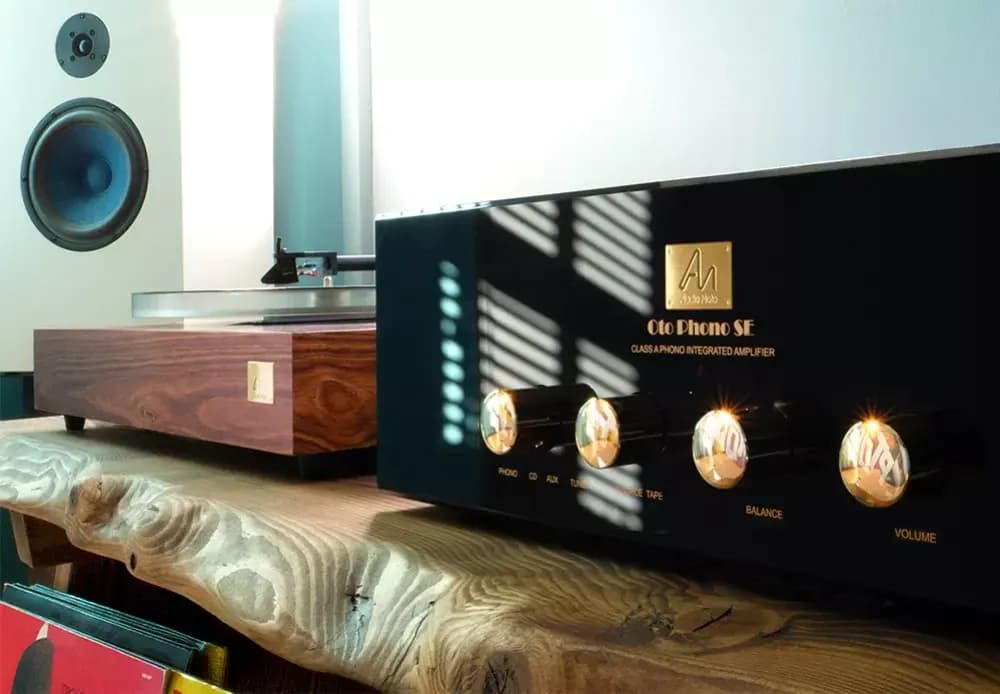
Audio Note OTO SE 35 35th Anniversary Edition Tube Integrated Amplifier Unveiled
By HiFi Editorial16 February 2026
Key Highlights
Audio Note (UK) marks 35 years of its Oto integrated amplifier with the Oto SE 35 35th Anniversary Edition, described as the most substantial redesign in decades.
Originally launched in 1991, the single-ended pentode tube amplifier was Audio Note’s first fully in-house design, proving high musicality at a more accessible price.
The anniversary model introduces newly designed output transformers, an upgraded choke-based power supply, optimized timing constants, and revised output stage circuitry.
What stands out in the anniversary OTO is not the checklist of new parts, but how Audio Note’s long‑held single‑ended pentode philosophy has been re‑balanced around drive and temporal coherence rather than headline power. Andy Grove’s comments hint that the redesign was influenced by recent work on Meishu, and that shows in the way the output stage has reportedly been re‑timed. In SE pentode amplifiers, small shifts in operating points and time constants can dramatically affect perceived bass articulation and rhythmic stability; the suggestion of a more physical low‑frequency presentation implies lower effective output impedance and tighter energy storage control, rather than simply more wattage. This aligns with Audio Note’s historic preference for transformer behavior and phase integrity over brute-force regulation.
Peter Qvortrup frames the OTO lineage as an exercise in timeless circuit architecture, while Grove emphasizes intuition guided by tube parameters and real‑world listening. These perspectives converge in the revised phono implementation. Increasing sensitivity inside the integrated amplifier changes more than gain structure: it shortens the signal path, reduces cumulative phase rotation, and minimizes noise contribution from additional active stages. From a purist standpoint, this is a meaningful move for vinyl‑centric systems using high‑efficiency loudspeakers, where every extra coupling capacitor and interface can blur microdynamics. Forum‑style discussion will likely center on whether the new phono topology better preserves leading‑edge transients and harmonic decay compared to earlier OTO generations.
Less obvious but equally relevant are the infrastructural changes—internal wiring geometry, shielding strategy, and mains transformer behavior—which tend to define the noise floor and tonal density in low‑power valve designs. Audio Note’s insistence on in‑house transformer design suggests a continued focus on bandwidth symmetry and saturation characteristics rather than textbook measurements. Taken together, the OTO SE 35 appears less like a commemorative refresh and more like a consolidation of three decades of incremental learning, aimed squarely at listeners who value timing, tone color, and system simplicity over feature creep.
HiFi Weekly Digest
New gear, best reads, and deals — every Friday.