OM System OM-3 Astro Mirrorless Camera Adds Hα Infrared Filter for Astrophotography
By HiFi Editorial15 February 2026
Key Highlights
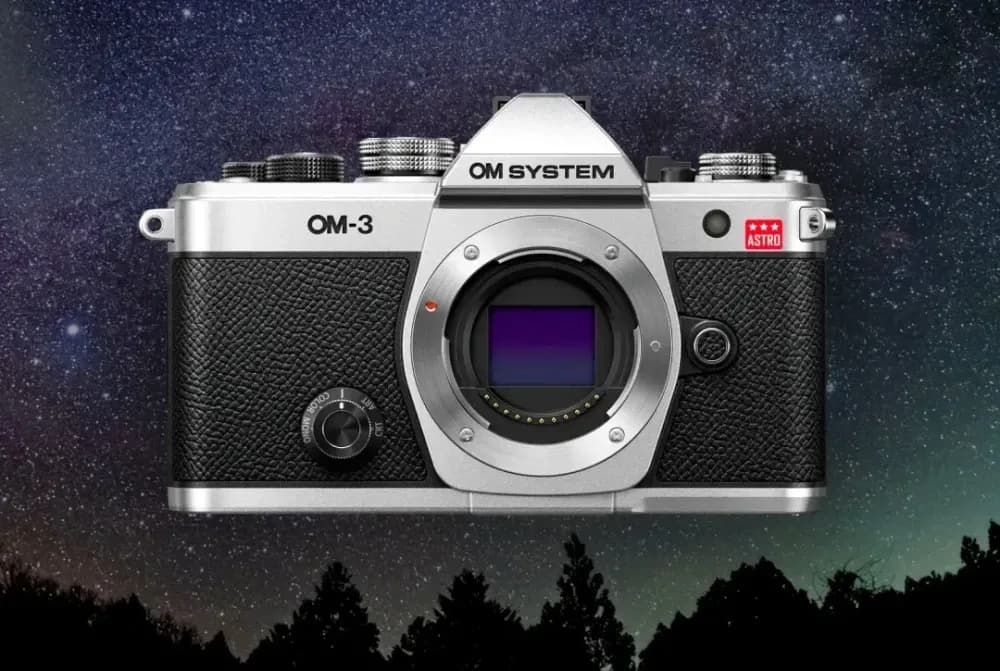
OM System announces OM‑3 Astro, a specialized mirrorless camera for astrophotography, launching March 2026 at $2,500—$500 more than the standard OM‑3.
Based on the February 2025 OM‑3, it features a 20.37‑MP BSI sensor, 4K/60p 10‑bit video, classic controls, and Olympus OM‑1 (1972) styling.
The key innovation is a custom infrared filter passing H‑alpha light at 656.28 nm, enabling accurate dark‑red nebula reproduction usually blocked by standard IR filters.
What separates OM‑3 Astro from the usual “astro‑ready” badge is not the headline modification itself, but the downstream consequences for the entire imaging chain. Allowing deep‑red energy to reach the sensor changes how the color matrix and white balance logic behave under mixed spectra. In practical terms, star fields dominated by broadband light will require more deliberate color management, while emission regions finally stop collapsing into muddy brown. It’s a philosophical choice that mirrors audiophile debates about removing a protective grille from a tweeter: transparency improves in the target band, but upstream discipline suddenly matters more. Compared with modified DSLRs of the past, OM System’s approach suggests tighter factory calibration rather than a brute‑force hack, which should reduce the magenta bias that often plagues H‑alpha‑friendly bodies.
There is also an interesting tension between sensor format and ambition. A smaller BSI sensor traditionally trades ultimate photon well capacity for portability, yet here it is paired with firmware tuned for extreme low‑contrast subjects. The benefit is not raw sensitivity, but consistency: pixel‑level response and microlens geometry are optimized for oblique light, which matters when stars hit the corners at fast apertures. Some sources frame this as a niche move, others as a pragmatic one—an alternative to heavy equatorial rigs where repeatability and power efficiency matter more than chasing full‑frame bragging rights. In that sense, OM‑3 Astro feels closer to a purpose‑built field recorder than a studio mic: limited, but honest about its operating envelope.
Video shooters looking skyward may find the most understated shift. With altered spectral transmission, the camera’s logarithmic profiles and 10‑bit pipeline gain new relevance for night timelapse and hybrid workflows, but only if grading is handled with restraint. Pushing saturation blindly will exaggerate noise in the red channel, much like boosting upper mids on a revealing DAC exposes recording flaws. OM System appears to be betting that its audience prefers tonal accuracy over spectacle—a stance that won’t please everyone, but aligns with a more purist reading of astrophotography as documentation rather than visual fireworks.
HiFi Weekly Digest
New gear, best reads, and deals — every Friday.