Get the weekly hi-fi digest — new gear, best reads, and deals.

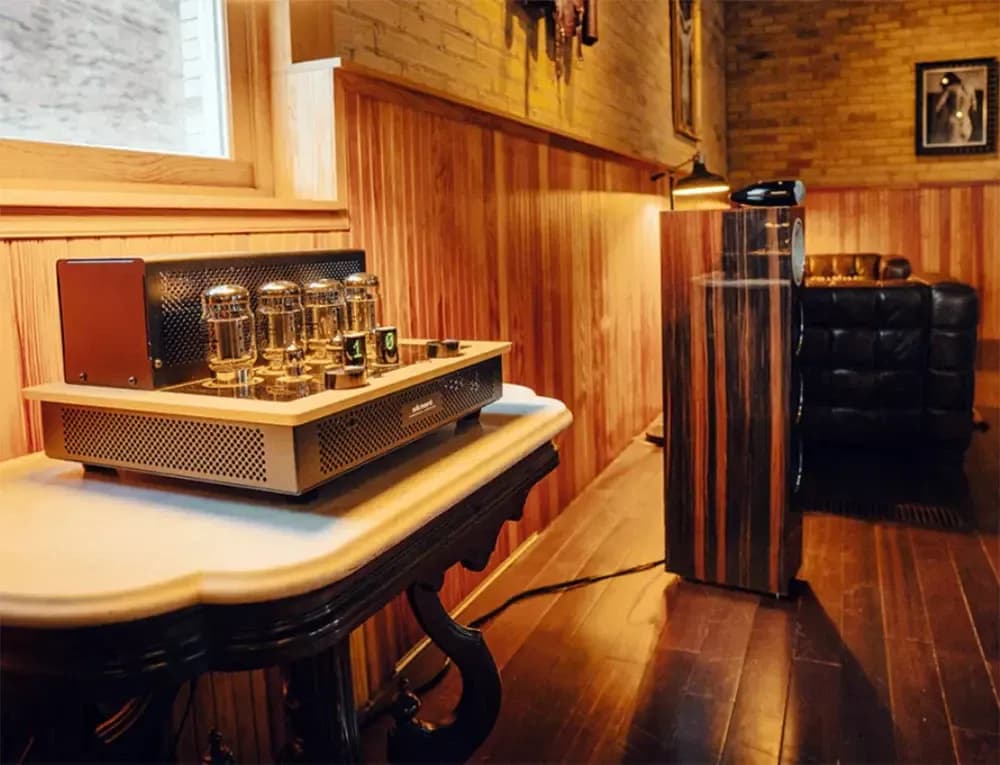
Audio Research I/55 is a compact tube integrated amplifier derived from I/70, succeeding I/50, targeting high-end listeners seeking classic tube sound with modern connectivity.
Fully tube-based amplification uses matched pairs of 6550 output tubes and 6922 input/driver tubes, adding Auto-Bias for continuous idle-current control without manual adjustment.
Rated at 2 × 50 W, the upgraded tube preamp offers wider gain range, stronger dynamics, Pre-Out outputs, and improved control with demanding loudspeakers.
Audio Research positions the I/55 at an interesting intersection where legacy circuit discipline meets contemporary system demands. On paper, the bandwidth extending well below the audible floor and out past 30 kHz hints at output transformers that are not merely scaled down from larger models, but carefully optimized for stability and phase behavior at realistic power levels. The relatively low distortion figure at 1 watt is telling here: this is an amplifier clearly engineered to spend most of its life in the first few watts, where harmonic structure and microdynamic nuance matter more than headline numbers. Input sensitivity and impedance are equally conservative, suggesting a preamp stage designed for wide compatibility with both modern balanced sources and traditional single‑ended components without flirting with noise or gain-matching issues.

One recurring discussion among tube enthusiasts is whether integrated designs compromise control when paired with complex loudspeaker loads. The inclusion of dedicated 4‑ and 8‑ohm taps, combined with a preamp section offering greater voltage swing than earlier iterations, addresses that concern from an engineering standpoint rather than through brute-force power. From a system‑building perspective, the presence of true pre‑outs changes the conversation entirely: the I/55 can function as a tube control center in hybrid setups, or evolve into a multi‑amp configuration as systems grow. This flexibility contrasts with purist integrated amplifiers that lock users into a fixed topology.
The digital and analog option cards reveal another philosophical split often debated in audiophile circles. Instead of treating digital as an afterthought, the internal signal handling—particularly the decision to upsample all incoming data—suggests a deliberate attempt to control jitter and filtering behavior within a known electrical environment. At the same time, the modular approach preserves a clean baseline for vinyl-centric listeners who prefer minimal internal circuitry. In that sense, the I/55 reads less like a “do‑everything” integrated and more like a carefully structured platform, allowing listeners to decide how far modern convenience should coexist with a traditional tube signal path.
New gear, best reads, and deals — every Friday.

* Duran Duran’s 1993 ‘The Wedding Album’ and 1995 ‘Thank You’ are reissued on vinyl for the first time since original 1990s pressings.

* Queen will release a 5CD+2LP super deluxe Queen II box set on 27 March 2026 via EMI, expanding the original 1974 album extensively.

* Harman International launches three JBL Quantum gaming headsets on February 26: Quantum 950 WIRELESS, 650 WIRELESS, and 250, priced at ¥55,000, ¥22,000, and…

* Audio-Technica launches the ATH-CKD7NC USB-C wired earphones on February 27, featuring hybrid noise cancelling and priced at ¥9,680 via direct sales.