Get the weekly hi-fi digest — new gear, best reads, and deals.

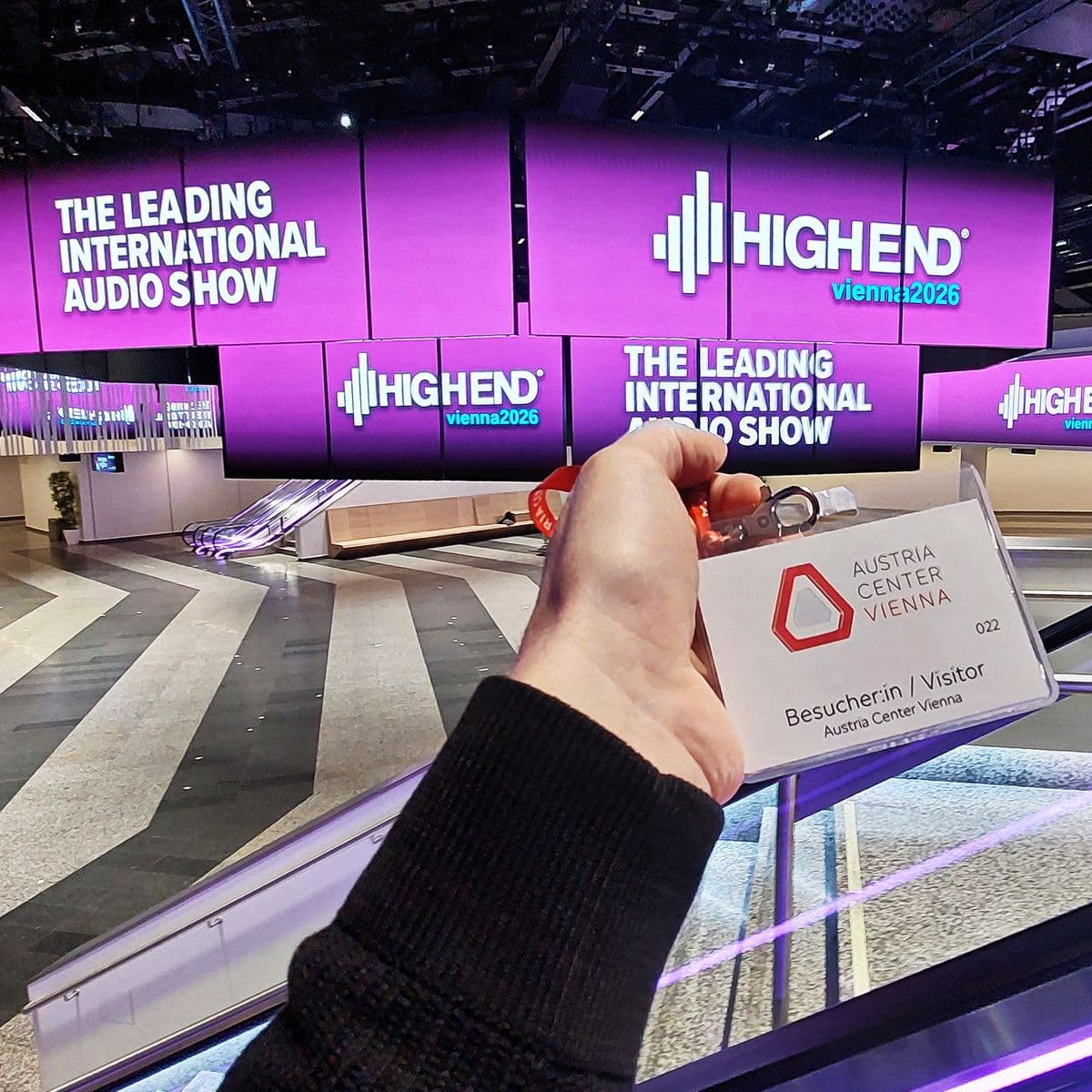
HIGH END 2026 audio exhibition will relocate to Austria Center Vienna (ACV) on June 4–7, 2026, marking the first move outside Germany in its 44-year history.
ACV is Austria’s largest conference center, offering 21 large halls, 134 smaller rooms, five levels, and modular spaces with movable walls providing up to -50 dB sound isolation.
The entire venue is sold out, with major brands like Audio-Technica, ELAC (100th anniversary), Yamaha, Bowers & Wilkins, and Marantz planning their largest or most ambitious displays ever.
What emerges from cross-reading the organizer briefings and venue-side commentary is that ACV is not merely “better treated” than legacy exhibition halls, but engineered around a different acoustic logic. The movable partition system—roughly 200 mm thick with multi-layer damping—suggests a focus on midband isolation rather than the token bass attenuation typical of fairground dividers. Several sources point out that the ceiling treatment is not decorative: suspended absorptive panels are tuned to control early reflections in the 300–1200 Hz range, precisely where show demos tend to collapse into glare. This shifts the exhibitor challenge away from emergency room correction (carpets, ad‑hoc diffusers) toward fine-tuning speaker placement and toe‑in, closer to how systems are voiced in semi‑permanent listening rooms.
There is also an interesting divergence in how brands interpret the same architectural constraints. Some see windowless rooms as liabilities; others, especially those planning large-scale analog or high-SPL presentations, read them as a gift—stable lighting, predictable reverberation time, and fewer external noise vectors. From a technical standpoint, the prevalence of wooden flooring across the venue changes the bass equation entirely: less stored energy than concrete, faster decay, and a more intelligible low‑mid transition. Compared with earlier German venues that favored sheer modular efficiency, ACV appears optimized for coherence and flow, both acoustically and logistically, which may explain why manufacturers are reportedly rethinking not just booth size but system topology and signal chains.
Finally, some observers frame the relocation as cultural symbolism, others as pure pragmatism. The more compelling interpretation sits between those poles. A congress center designed for diplomatic speech intelligibility, multilingual translation, and fatigue-free long sessions inadvertently aligns with the needs of high-end audio demonstration: controlled SPL, low noise floor, and listener endurance. In forum terms, this is less about “wow factor” and more about reducing variables. If that holds in practice, HIGH END may quietly evolve from a gear safari into something closer to a distributed listening laboratory—still commercial, still competitive, but finally less hostile to the sound itself.
New gear, best reads, and deals — every Friday.

* The Crossover EC Zero T, a portable CD player, is a collaboration between SHANLING and MOONDROP, limited to 2000 units globally.

* The bPower CryoFly by bFly-Audio uses cryogenic treatment to enhance conductor electrical properties, aimed at improving sound clarity and dynamics.

* Samsung Display introduces the Penta-Tandem technology for its QD-OLED panels, enhancing performance and durability significantly.

* The M3 Plus ASANO TANCH Edition DAP, a collaboration between SHANLING and TANCHJIM, launches globally on February 20, limited to 2,000 units.