Innosonix Multichannel Professional Audio Amplifiers Using EPC GaN Transistors for High-Density Class-D Design
By HiFi Editorial19 February 2026
Key Highlights
Innosonix, partnering with EPC since 2020, was an early adopter of GaN transistors in professional Class-D audio amplifiers, overcoming industry reliability concerns.
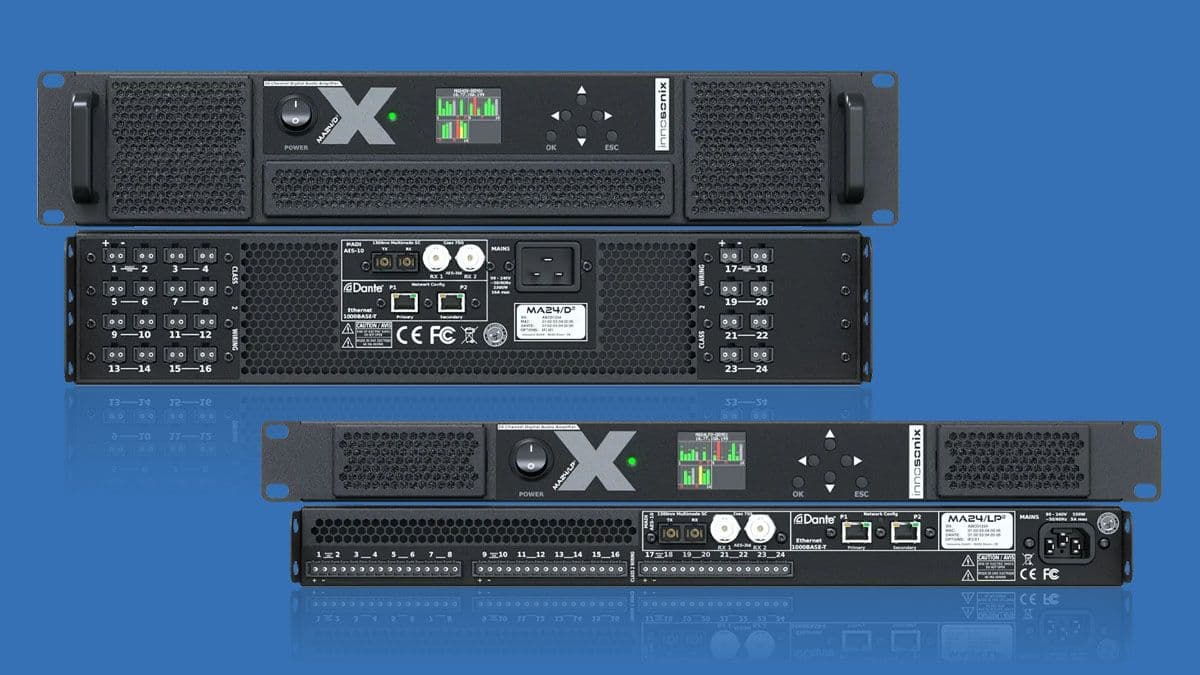
Its multichannel amplifiers offer high-density 1U/2U racks with 16–32 channels, FPGA-based DSP, and Dante/AES67 or MADI networking for immersive audio installations.
GaN-based designs target 50–300 W per channel using ±60 V rails, leveraging EPC2059 150 V eGaN FETs for improved switching efficiency and fidelity.
What separates Innosonix from the usual “Class‑D done right” narrative is not brute-force output, but an almost obsessive focus on how audio signals actually stress an output stage. Instead of chasing ever-lower RDS(on), the design philosophy leans into switching-loss optimization, acknowledging that music’s high crest factor keeps average currents modest while transitions dominate thermal behavior. This is where GaN’s low charge storage and negligible reverse recovery translate into audible benefits: cleaner zero crossings, less modulation noise riding on the carrier, and a subjective sense of ease at low levels that silicon-based stages often smear. EPC’s unusually open reliability documentation also plays a quiet but important role here, allowing Innosonix to treat GaN less like an exotic component and more like a predictable building block, shortening the gap between theoretical performance and deployable hardware.
From a system perspective, the interesting story is how aggressively the platform balances speed against control. Fast edges are a double-edged sword in dense multichannel layouts, so Innosonix deliberately tempers dv/dt with gate resistance rather than letting the modulator and PCB parasitics fight it out. The result is a calmer noise floor without sacrificing the temporal precision that makes GaN attractive in the first place. Moving from chip-scale devices to QFN-packaged FETs reinforces this pragmatism: slightly larger footprints, but far better solder consistency and mechanical resilience over years of thermal cycling. Early hiccups reportedly traced back to stencil geometry rather than silicon behavior, a reminder that with GaN, manufacturing discipline is as critical as circuit theory.
Looking ahead, the more intriguing implication is architectural rather than purely sonic. Extending GaN beyond the output stage into power conversion—LLC resonant supplies and advanced PFC—suggests a convergence where amplification and energy management share the same fast, low-loss device physics. For installations running around the clock, that means fewer components, tighter thermal envelopes, and a stability profile that scales with channel count instead of collapsing under it. In audiophile terms, it’s less about headline wattage and more about the confidence that the amplifier will sound the same at hour ten thousand as it did on day one—quiet, controlled, and unflustered by complexity.
HiFi Weekly Digest
New gear, best reads, and deals — every Friday.