Get the weekly hi-fi digest — new gear, best reads, and deals.

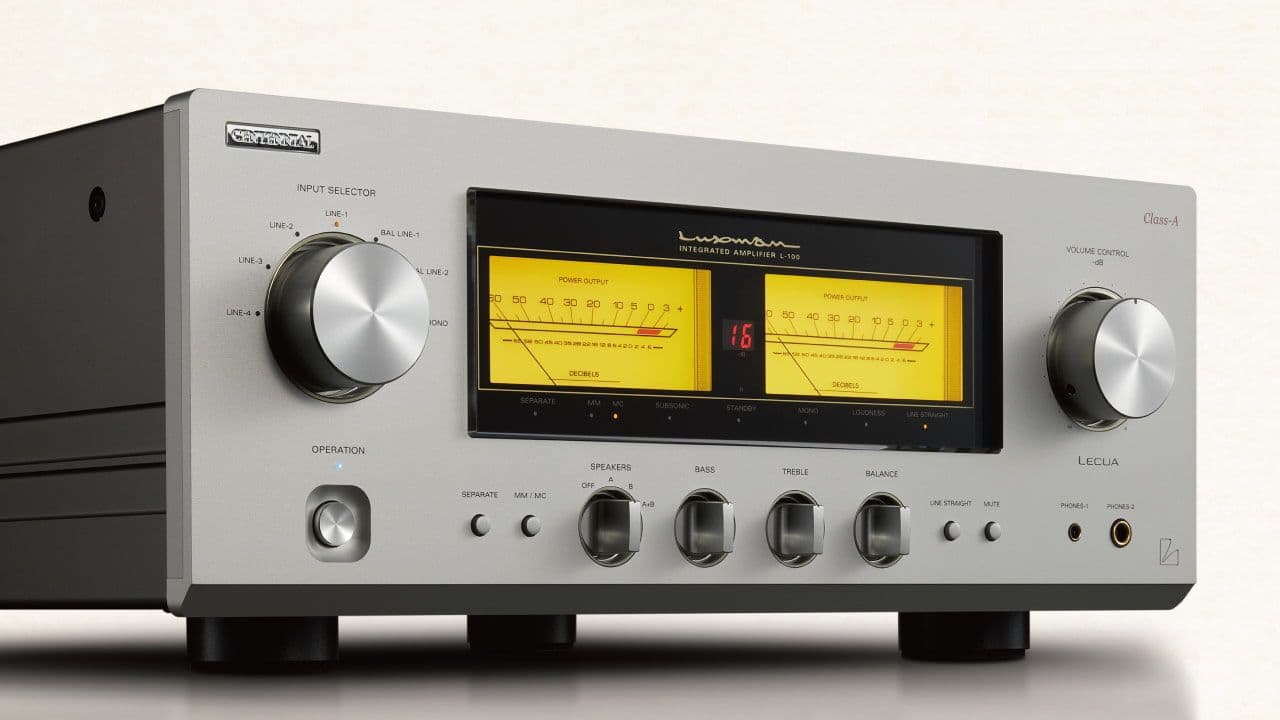
Luxman enters its second century with D-100 SACD/CD Player and L-100 Centennial Integrated Amplifier, defining a long-term, high-end engineering direction rather than anniversary editions.
L-100 is a pure Class A integrated amplifier rated 20W/8Ω and 40W/4Ω, using triple-parallel bipolar push-pull outputs and 80,000µF power supply.
Luxman’s LIFES 1.1 feedback architecture and LECUA1000 88-step attenuator deliver 0.005% THD, 300 damping factor, balanced inputs, MM/MC phono, and dual headphone outputs.
What stands out across coverage is how deliberately conservative Luxman’s engineering posture remains in an industry increasingly obsessed with feature stacking and software-defined upgrades. The L-100’s low-power Class A topology is less about nostalgia and more about maintaining predictable operating conditions across the entire signal swing. By keeping output devices biased on at all times and pairing that with a high-current supply, Luxman prioritizes linear behavior into real-world loads rather than spec-sheet theatrics. Compared to contemporary high-power Class A/B integrateds from brands like Mark Levinson or Goldmund, Luxman’s approach reads almost stubborn—yet the unusually high control factor for a Class A design suggests careful attention to output impedance and power rail stiffness, not just romantic notions of purity.
The more interesting technical discussion centers on LIFES 1.1, which multiple sources frame as an evolution rather than reinvention. Unlike heavy global feedback loops that can bleach microdynamics, Luxman’s distortion-sensing method works locally, correcting errors without flattening transient behavior. In practical terms, this aligns the L-100 closer to Pass Labs’ low-feedback philosophy than to the ultra-measured, ultra-controlled school of modern Japanese mega-brands. The same thinking carries into the LECUA-based volume control, which avoids the sonic drift common to relay ladders at low levels by keeping impedance behavior stable across steps—something forum regulars tend to notice long before they quote measurements.
The D-100 completes the picture by treating disc playback as a mechanical problem first and a digital one second. Where many SACD players lean on off-the-shelf transports and DSP-heavy correction, Luxman’s emphasis on chassis rigidity, clock stability, and analog stage symmetry reflects an older but still relevant belief: timing errors and vibration are best prevented, not fixed downstream. The choice of ROHM conversion over more ubiquitous ESS or AKM silicon also signals voicing intent rather than cost optimization. Taken together, the D-100 and L-100 don’t chase the future of hi-fi as much as they define a stable endpoint—hardware meant to be learned, lived with, and left untouched while the rest of the market keeps refreshing itself.
New gear, best reads, and deals — every Friday.

* Diesel introduces a wired headphone model, blending bold design with functionality, showcasing the brand's signature style.

* The Telegrapher Raccoon is a compact near-field two-way monitor featuring a 6-inch woofer, 1-inch tweeter, and passive radiator.

* Knowles has introduced a new family of multi-way balanced armature drivers, designed to enhance premium TWS earbuds and in-ear monitors.

* The Toneoptic CAN is a modular vinyl record storage solution featuring stackable crates with embedded handles for easy access.