Soulnote Series 1 Ver.2 Launch: A-1 Ver.2 Integrated Amplifier, D-1 Ver.2 DAC, and E-1 Ver.2 Phono Preamplifier
By HiFi Editorial6 March 2026
Key Highlights
Soulnote celebrates its 20th anniversary with Serie 1 Ver.2, introducing upgraded integrated amplifier, DAC, and phono preamp, all designed and manufactured in Japan.
The Serie 1 Ver.2 philosophy avoids negative feedback and digital correction, using discrete non-NFB circuits, short signal paths, and mechanically optimized chassis for unaltered signal purity.
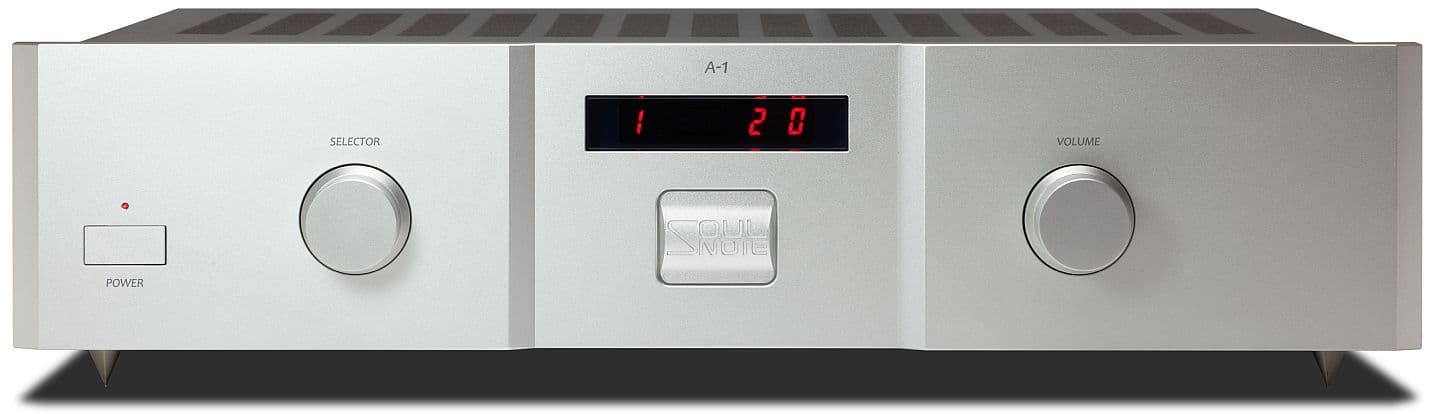
Soulnote A-1 Ver.2 integrated amplifier delivers 2×80 W at 4 ohms, featuring a single-push-pull output stage with TO-3P transistors and an unpotted toroidal transformer.
Soulnote’s Ver.2 refresh reads less like a feature update and more like a tightening of engineering tolerances across the board. One recurring theme across sources is the brand’s fixation on bias stability as a sonic determinant. The newly developed bias networks—implemented via carefully tuned RC constellations rather than active regulation—aim to suppress parasitic resonances at the transistor level. This is particularly relevant in wide-bandwidth discrete designs, where thermal drift and micro-oscillation tend to blur low-level information. By treating bias not as a static operating point but as a resonance-managed subsystem, Soulnote is clearly addressing time-domain behavior rather than textbook linearity figures, a stance that aligns with how many Japanese designers prioritize phase integrity over bench metrics.
The integrated amplifier’s output stage architecture also reveals an interesting contrast in perspectives. While some manufacturers pursue ever-higher damping factors through heavy control circuitry, Soulnote instead relies on a multi-stage Darlington topology with physically short current paths and a mechanically “free” transformer core. The decision to leave the toroidal transformer unpotted is not about cost-saving, but about preserving magnetic compliance under dynamic load. This approach suggests that instantaneous current delivery—and how quickly the supply recovers from transients—was given precedence over absolute noise suppression. It’s a design choice often debated in audiophile circles, where unpotted transformers are associated with greater liveliness but demand more careful mechanical grounding.
On the digital and analog front ends, the divergence from mainstream thinking becomes even clearer. The DAC’s ESS implementation is notable not because of the chip itself, but because of how aggressively Soulnote distances itself from the typical “hyper-processed” ESS sound. Running the converters in a configuration that emphasizes timing accuracy over algorithmic correction reframes the ES9039PRO as a precision current source rather than a feature-rich DSP platform. Similarly, the phono stage’s readiness for optical cartridges points to an unusually future-proof mindset, acknowledging that non-inductive pickup systems place radically different demands on input impedance and noise behavior. Taken together, Serie 1 Ver.2 feels less like a product line chasing trends, and more like a coherent statement on how mechanical, electrical, and temporal factors intersect when signal purity is the primary design goal.
HiFi Weekly
Newsletter
Get the week's top trending stories, best deals, and new product launches — straight to your inbox.