Get the weekly hi-fi digest — new gear, best reads, and deals.

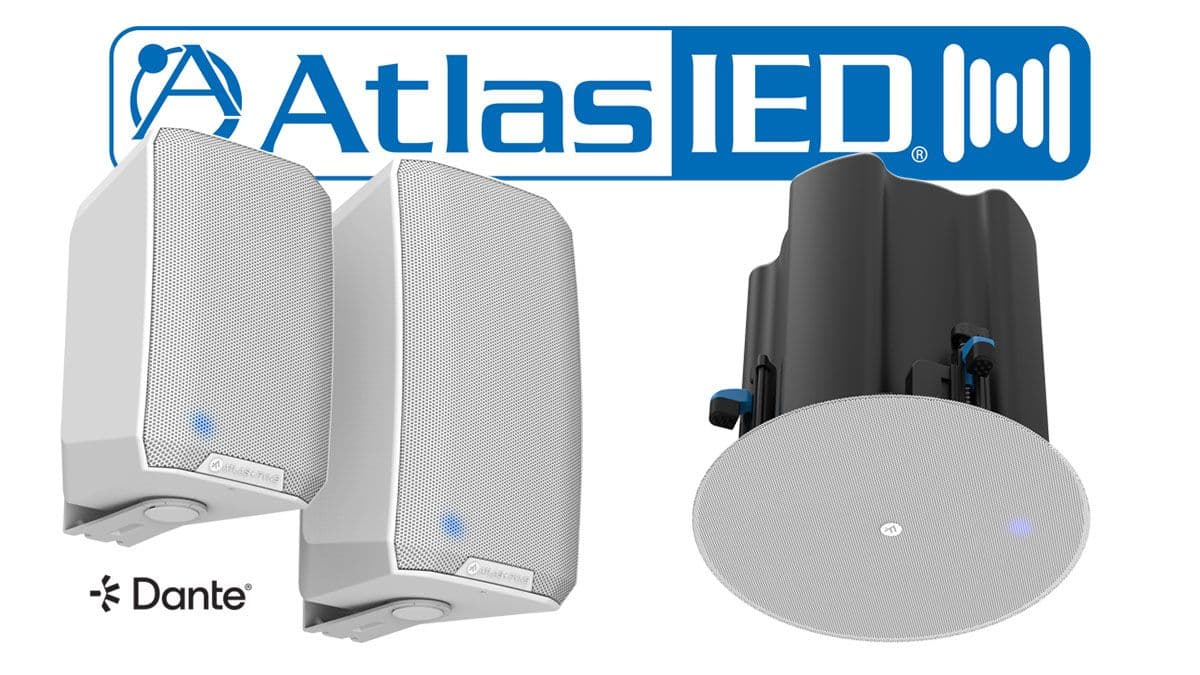
AtlasIED unveiled Atlas+Fyne FC-D ceiling and FS-D surface-mount speakers at ISE 2026, leveraging PoE++ and Dante networking for single-cable, full-bandwidth audio.
Unlike typical PoE speakers, the coaxial Atlas+Fyne designs use PoE++ power to deliver higher headroom, dynamic range, and premium output without sonic compromise.
Each speaker integrates Fyne Audio’s Isoflare point-source driver, ensuring phase-coherent summation, constant directivity, lobe-free dispersion, and predictable coverage for commercial installations.
What makes the Atlas+Fyne expansion interesting is less the headline grab of PoE++ and more how AtlasIED is clearly betting on power budget as an acoustic enabler rather than a constraint. Earlier PoE loudspeakers tended to feel like networked convenience products with compressed macro-dynamics, but PoE++ finally provides enough current headroom to support meaningful amplifier rail voltage and transient capability. In practice, that opens the door to wider crest factors and less aggressive limiting, which matters when Dante-fed content ranges from low-level background streams to high-impact program material. From an installed-audio perspective, this narrows the historical gap between distributed network speakers and locally amplified systems, especially in applications where consistent voicing and predictable SPL are more valuable than brute-force wattage.
The Isoflare driver choice also signals a deliberate move away from “good enough” dispersion control. Coaxial designs are common, but the mechanical alignment of the HF and LF elements here addresses time-domain behavior in a way integrators usually associate with higher-end studio or heritage hi‑fi designs. Constant directivity is not just about even coverage maps; it directly affects tonal stability as listeners move off-axis, reducing the familiar combing and phase smear that plague many ceiling systems. That lineage matters: Fyne Audio’s engineering DNA traces back to classic point-source thinking, and AtlasIED appears to be leveraging that to make networked speakers behave more like coherent sound sources than ceiling tiles with Ethernet ports.
Seen alongside the new DMA and LMA amplification platforms, the broader strategy becomes clearer. AtlasIED is quietly building a modular ecosystem where signal transport, power delivery, and acoustic behavior are tightly aligned, rather than stitched together from disparate boxes. The choice to keep the LMA amplifiers DSP-free suggests an understanding that not every zone needs layers of processing, while the DMA’s onboard control caters to environments where tuning agility matters. For integrators and specifiers, this feels less like a product launch cycle and more like a recalibration of what “networked commercial audio” is supposed to sound like when sonic priorities are allowed back into the conversation.
New gear, best reads, and deals — every Friday.

* The M3 Plus ASANO TANCH Edition DAP, a collaboration between SHANLING and TANCHJIM, launches globally on February 20, limited to 2,000 units.

* Steven Wilson announced the release of his new concert album, 'Impossible Tightrope,' recorded live in Madrid.

* Knowles has introduced a new family of multi-way balanced armature drivers, designed to enhance premium TWS earbuds and in-ear monitors.

* Samsung Display introduces the Penta-Tandem technology for its QD-OLED panels, enhancing performance and durability significantly.