Get the weekly hi-fi digest — new gear, best reads, and deals.

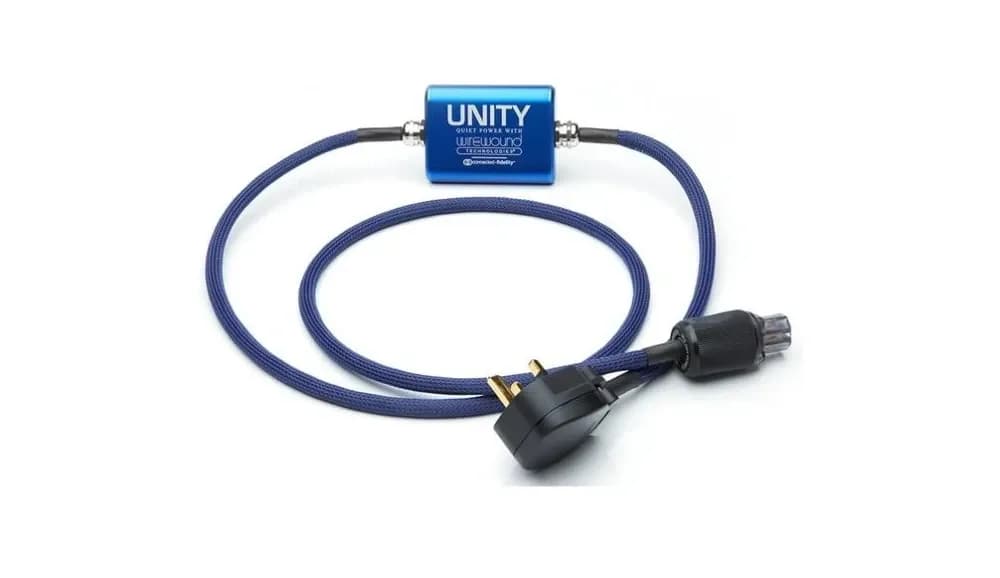
British audio firm Connected-Fidelity unveiled the Unity power cable using proprietary wirewound technology, claiming clearer sound, stronger dynamics, and more precise soundstage.
The cable integrates a passive in-line module containing coils on specialized cores, correcting parasitic inductance and capacitance while linearizing energy delivery.
According to the manufacturer, the design minimizes phase distortion and suppresses EMI/RFI noise, aiming to improve transparency and low-level detail retrieval.
Connected-Fidelity’s Unity slots into a familiar but contentious corner of the audiophile landscape: power delivery as a tuning element. The company’s wirewound approach echoes classic choke-based conditioning, yet the emphasis here is not current limiting but impedance shaping across a broad frequency range. By placing wound elements on bespoke cores within an in-line module, the design appears aimed at stabilizing the interaction between the wall supply and an amplifier’s rectification stage, where fast transient current draw can excite reactive behavior in conventional cables. From a technical standpoint, this suggests an attempt to smooth energy flow without resorting to active regulation or bulky external conditioners.

What makes Unity interesting is how it contrasts with minimalist “straight-through” cable philosophies often favored by measurement-driven designers. Those camps typically argue for low resistance and nothing more, while Connected-Fidelity leans toward controlled reactance as a tool to manage phase relationships and high-frequency interference riding on the mains. In forum-style debates, this is where opinions usually diverge: some view embedded coils as elegant analog solutions, others as unnecessary complexity. Unity’s construction implies careful tuning to avoid overdamping, a risk when inductive elements are introduced too aggressively.
From a system-matching perspective, such a cable is likely conceived with modern high-resolution digital front ends and wide-bandwidth amplifiers in mind, where susceptibility to upstream noise is higher. Rather than acting as a blunt filter, the wirewound module can be interpreted as a passive network intended to linearize how energy is delivered under dynamic load. Whether one subscribes to that school of thought or not, Unity clearly positions itself as a considered engineering response to power-line behavior, not merely a cosmetic or materials-driven exercise.
New gear, best reads, and deals — every Friday.

* Shokz Japan appointed Sakanaction frontman Ichiro Yamaguchi as brand ambassador, launching the collaboratively designed open-ear wireless earbuds, OpenFit 2+…

* Munich launches the inaugural Munich HiFi Days in March, filling the gap left by the departed international High End trade show.

* Audio Research I/55 is a compact tube integrated amplifier derived from I/70, succeeding I/50, targeting high-end listeners seeking classic tube sound with m…

* Nagra Compact Player is a complete high-end digital source integrating advanced streaming, a built-in DAC, and dual-mono analog outputs for improved channel…