Get the weekly hi-fi digest — new gear, best reads, and deals.

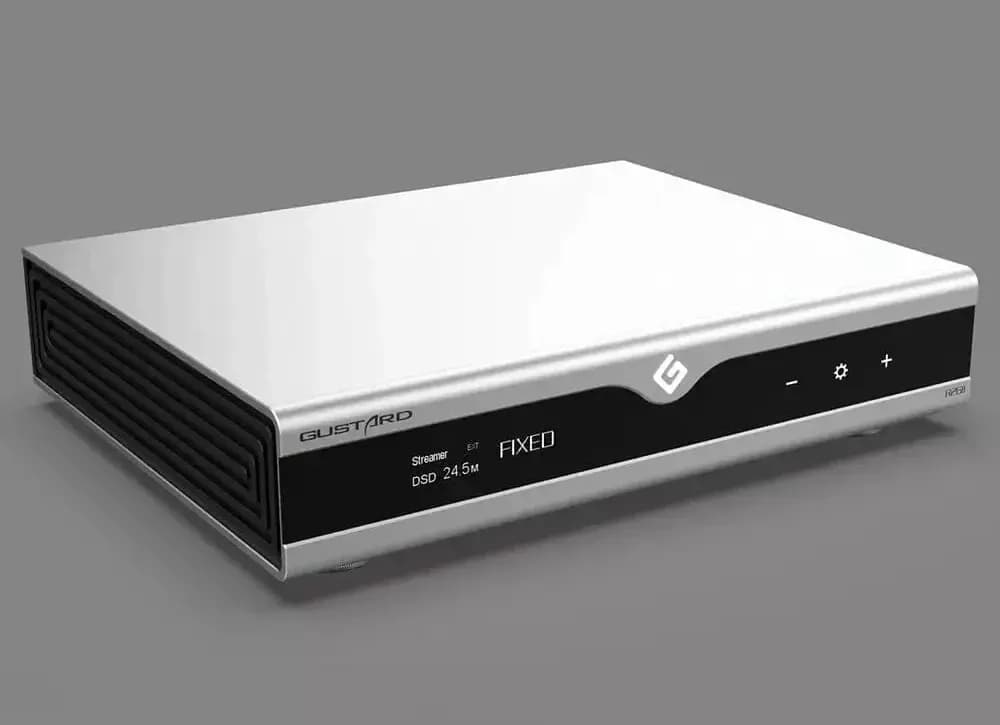
Gustard R26II is a second-generation R2R DAC/streamer featuring a fully discrete 26-bit R2R architecture derived from flagship R30, quadrupling resolution over its predecessor.
The DAC supports native 1-bit DSD processing, achieving over 130 dB dynamic range for black backgrounds and the organic, textured sound prized by R2R enthusiasts.
Digital inputs include USB-B and LAN with native DSD512 support, plus I2S handling up to DSD2048 and PCM 1536 kHz for extreme-resolution playback.
Positioned as more than a simple revision, the R26II reads like Gustard’s attempt to consolidate two traditionally opposing schools of digital audio: purist discrete conversion and modern network-centric playback. Where earlier R2R designs often relied on external streamers or transport-grade sources, the R26II integrates its streaming logic deeply into the digital domain, suggesting that Gustard now treats the network interface as part of the signal chain rather than a convenience add‑on. This shift aligns with a broader industry trend, yet the implementation here remains resolutely hardware-driven, with emphasis on deterministic processing paths and clock discipline rather than heavy software abstraction.
From a technical standpoint, the decision to carry over core ideas from the flagship R30 hints at a trickle-down strategy focused on linearity and temporal accuracy rather than headline features. The discrete ladder topology is paired with a native DSD handling philosophy that avoids format conversion inside the DAC core, a choice often debated in audiophile circles. Advocates argue this preserves microdynamics and phase coherence, while skeptics point to the complexity of maintaining stability at extreme sample rates. Gustard’s answer appears to be rigorous clock management and physical separation of subsystems, reinforcing the notion that digital noise and timing errors are treated as primary design enemies rather than secondary concerns.
Equally telling is the analog stage philosophy. By rejecting op-amp based solutions in favor of a fully discrete Class A output, Gustard aligns the R26II with designs typically seen in cost-no-object converters, where current delivery and harmonic structure are shaped in the analog domain rather than corrected afterward. This, combined with an overbuilt power supply architecture, frames the R26II less as a “feature-rich DAC” and more as a balanced digital front end aimed at long-term system matching. In that sense, the R26II doesn’t chase novelty; it refines a coherent engineering narrative that prioritizes signal integrity from Ethernet packet to analog waveform.
New gear, best reads, and deals — every Friday.

HiFi.De
* Disney+ has completely removed HDR support, including HDR10, HDR10+, and Dolby Vision, due to an ongoing patent dispute affecting all subscription tiers.

* Munich launches the inaugural Munich HiFi Days in March, filling the gap left by the departed international High End trade show.

* Starting in 2026, Dirac Live software licenses will be sold in-person at HiFi Klubben stores across Denmark, Norway, Sweden, Germany, and the Netherlands.

* Marshall releases Mode USB-C wired earphones featuring a USB-C plug, priced at ¥8,990, targeting modern smartphones lacking 3.5mm headphone jacks.