Get the weekly hi-fi digest — new gear, best reads, and deals.

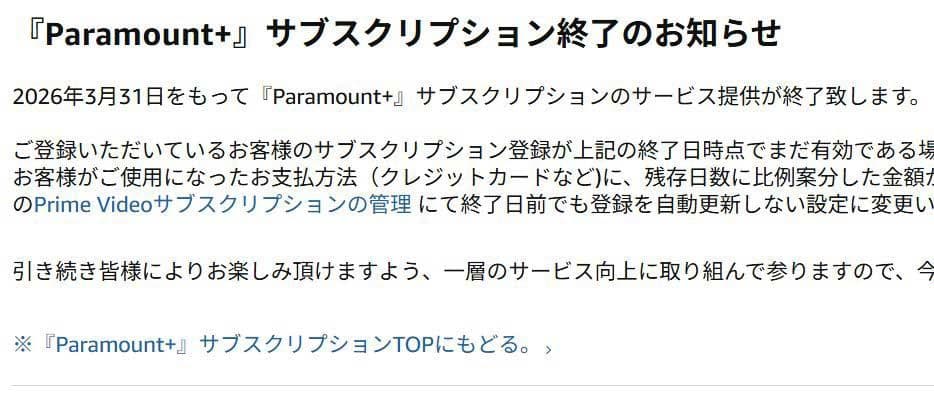
Prime Video will discontinue the Paramount+ add-on service in Japan on March 31, ending the ¥770 monthly subscription offering within the platform.
Active Paramount+ subscriptions will automatically terminate on March 31, even if the billing period extends beyond the official service shutdown date.
Customers with remaining paid days after March 31 will receive prorated refunds, credited back to their original payment methods, such as credit cards.
From a signal-chain perspective, the withdrawal of Paramount+ from Prime Video highlights the fragility of platform-level integrations rather than the content brand itself. Prime Video Channels operate as a middleware layer, abstracting playback, DRM, and adaptive bitrate logic into Amazon’s own pipeline. While this offers convenience, it also locks services like Paramount+ into Amazon’s encoding profiles and audio configurations, typically capped at standardized Dolby Digital Plus rather than the more aggressive bitrate ladders seen on native apps. For viewers running resolving AVRs and full-range speaker arrays, this often translated into competent but conservative sound—clean dialog, restrained LFE, and little room for dynamic headroom compared with disc or higher-bitrate OTT implementations.

By contrast, Paramount+ distribution through cable-affiliated and broadcaster-backed platforms in Japan suggests a different tuning philosophy. Services such as J:COM STREAM or WOWOW On Demand tend to retain tighter control over stream packaging, sometimes prioritizing stability over peak quality, but avoiding the additional abstraction layer imposed by an aggregator like Prime Video. From an enthusiast standpoint, this can mean fewer surprises in level matching and metadata handling, especially with multichannel mixes from franchises like Star Trek or Mission: Impossible, where spatial cues and score dynamics are integral to the experience.
Strategically, this move also underscores a broader industry tension between reach and fidelity. Aggregators excel at scale, but for studios with deep catalogs and technically demanding content, direct or semi-direct distribution allows finer control over codecs, audio flags, and future format upgrades. For listeners who treat streaming not as background noise but as a critical source component, the shift may ultimately encourage choosing platforms less for UI convenience and more for how faithfully they pass the signal downstream to the speakers.
New gear, best reads, and deals — every Friday.

* AES Europe Convention 2026 marks the 160th AES event, held May 28–30 at the Technical University of Denmark (DTU) in Copenhagen’s Lyngby campus.

* Revival Audio, founded in 2021 in Alsace, launches the Atalante Grande Réserve, a flagship, limited to 300 pairs and distributed in Germany by B&T HiFi.

* Luxman enters its second century with D-100 SACD/CD Player and L-100 Centennial Integrated Amplifier, defining a long-term, high-end engineering direction ra…

* Smashing Pumpkins will celebrate the 35th anniversary of their 1991 debut album *Gish* with a single-LP vinyl reissue released on 29 May 2026 via UMR.