Get the weekly hi-fi digest — new gear, best reads, and deals.

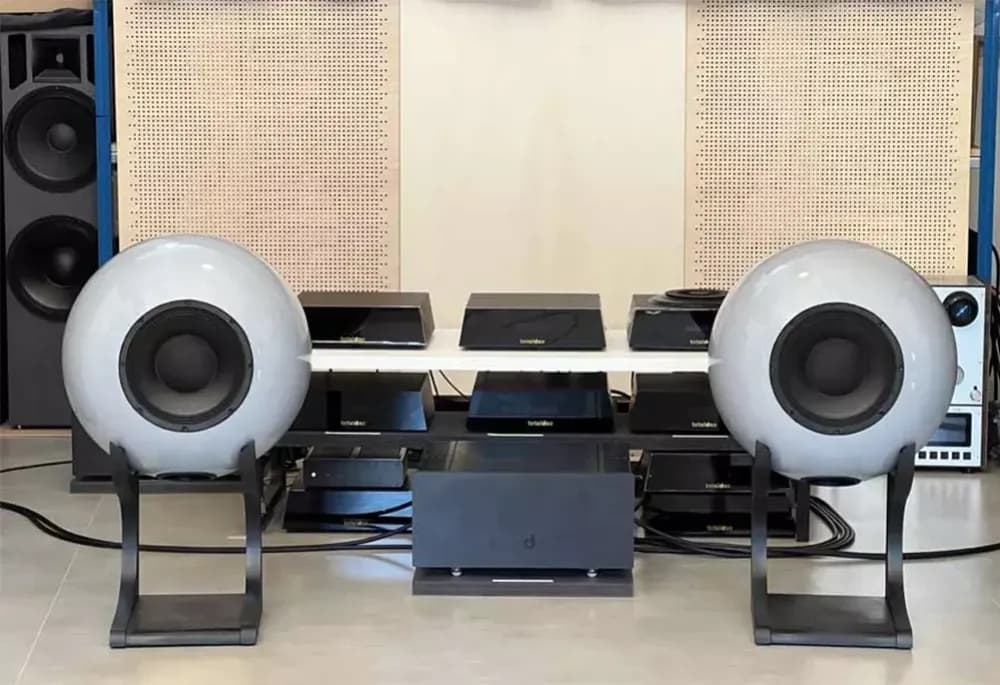
Totaldac Balloon is a passive spherical loudspeaker designed as a wideband point source, suitable for small and large rooms.
The 500 mm one-piece spherical cabinet minimizes edge diffraction, improving phase coherence and precise sound radiation from a true point source.
A coaxial two-way driver combines a 10-inch woofer with a 1-inch compression tweeter and circular horn hidden behind the dust cap.
From an engineering standpoint, Balloon reads as a deliberate rejection of conventional box logic rather than a styling exercise. A true sphere pushes panel resonances into less correlated modes and, more importantly, removes the baffle geometry that usually dictates where diffraction artifacts show up in the time domain. Compared to classic wide-baffle or faceted enclosures, this approach prioritizes phase integrity over brute-force damping. The choice of a coaxial motor assembly aligns with that philosophy: aligning acoustic centers through the midband and treble reduces the need for steep electrical correction, which helps explain why Totaldac emphasizes mechanical coherence and externalized filtering rather than complex internal bracing or DSP band-aids.

The coaxial implementation itself hints at a studio-monitor lineage rather than a domestic hi‑fi one. A compression driver loaded by a short, circular waveguide integrated into the woofer cone tends to favor controlled directivity and stable off-axis response, something forum regulars often associate with “walk-around consistency.” Unlike many coaxials that struggle with cone breakup interacting with the horn throat, hiding the waveguide behind an acoustically transparent dust cap suggests an attempt to smooth impedance transitions and reduce HF reflections back into the diaphragm. The relatively low physical profile and dedicated stand geometry further suggest that vertical dispersion and floor-bounce behavior were treated as first-order problems, not afterthoughts.
Equally telling is the decision to move the crossover out of the enclosure and wire it point-to-point. In audiophile circles this is often read less as voodoo and more as a way to isolate reactive components from vibration and magnetic fields inside the cabinet. Using air-core inductors and film capacitors of generous physical size typically implies low series resistance and minimal saturation effects, which pairs logically with a high-efficiency motor system. In that context, Balloon positions itself closer to purist, high-sensitivity loudspeakers that value immediacy and microdynamic contrast, while borrowing dispersion control ideas more often seen in modern professional designs.
New gear, best reads, and deals — every Friday.

HiFi.De
* Disney+ has completely removed HDR support, including HDR10, HDR10+, and Dolby Vision, due to an ongoing patent dispute affecting all subscription tiers.

* Munich launches the inaugural Munich HiFi Days in March, filling the gap left by the departed international High End trade show.

* Starting in 2026, Dirac Live software licenses will be sold in-person at HiFi Klubben stores across Denmark, Norway, Sweden, Germany, and the Netherlands.

* Marshall releases Mode USB-C wired earphones featuring a USB-C plug, priced at ¥8,990, targeting modern smartphones lacking 3.5mm headphone jacks.