Mercedes-Benz Introduces Fraunhofer IDMT Audiofields 3D Audio Technology with Burmester Systems in Series Production Vehicles
By HiFi Editorial9 March 2026
Key Highlights
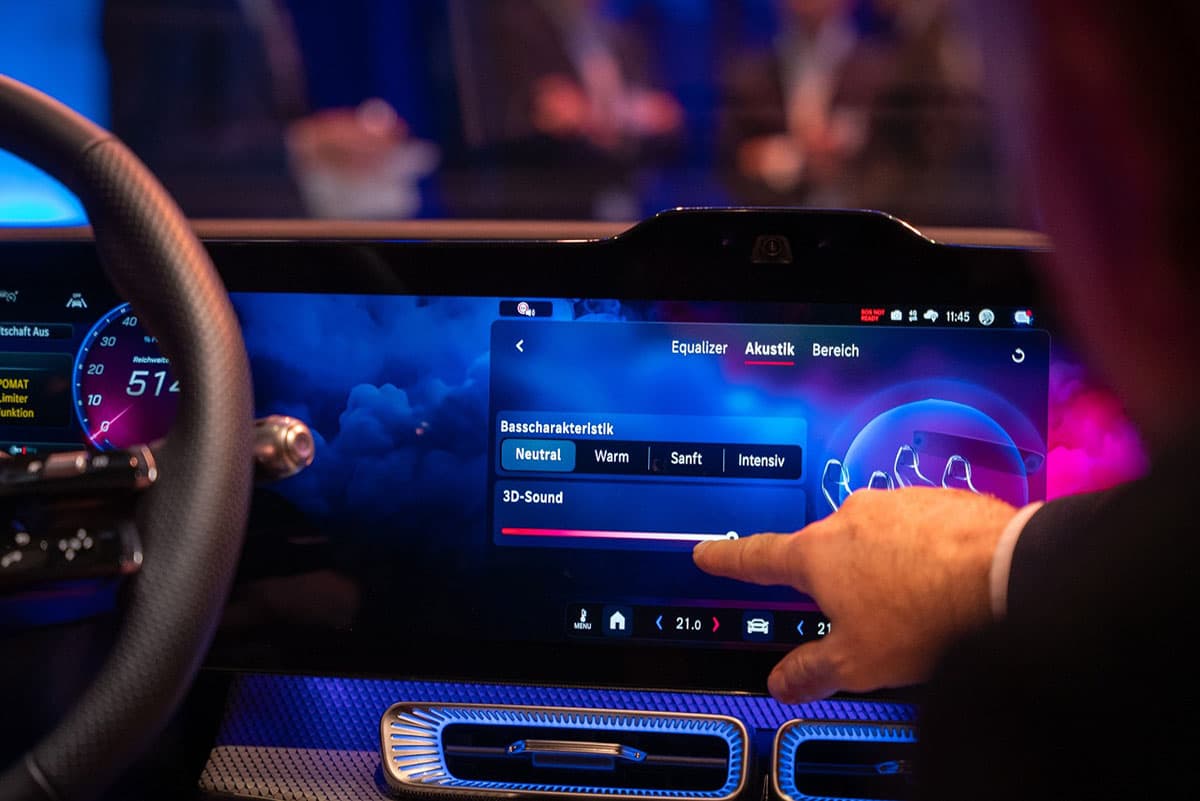
Fraunhofer IDMT’s object-based 3D audio technology, now renamed Audiofields, enters series production vehicles with Mercedes-Benz and Burmester, delivering fully immersive cabin-wide spatial sound.
Audiofields debuts in Mercedes-Benz CLA, GLC, GLB, and S-Class models featuring latest MBUX infotainment and premium or high-end Burmester sound systems.
The technology transforms conventional stereo music, radio, and audiobooks into adjustable 3D soundscapes, allowing users to control surround intensity from subtle ambience to expansive immersion.
What makes Audiofields particularly interesting from a hi‑fi perspective is not the headline “3D” effect, but the way Fraunhofer approached object rendering under real automotive constraints. Unlike traditional matrix surround or cabin EQ tricks, the algorithm operates at the object level while remaining agnostic to speaker topology. Burmester engineers emphasize that this allowed tuning to focus on temporal coherence and phase stability rather than brute-force channel expansion. The result, according to development sources, is a soundstage that scales naturally with cabin geometry, preserving center image solidity and avoiding the hollowed-out midrange often associated with aggressive spatializers in cars.
Fraunhofer’s long background in large-scale sound reinforcement clearly shaped the signal processing philosophy. The automotive version appears optimized for low-latency execution on shared vehicle processors, suggesting heavy use of perceptual models and simplified HRTF abstractions rather than computationally expensive binaural rendering. This is where perspectives subtly diverge: Fraunhofer frames Audiofields as a platform for holistic vehicle acoustics, while Mercedes-Benz positions it as a refinement layer within the broader MBUX ecosystem. For audiophiles, that distinction matters—Audiofields is not merely an effect on top of Burmester voicing, but an embedded rendering stage that influences how tonal balance, depth cues, and localization interact across all audio sources.
Burmester’s involvement also hints at why the system avoids the “demo-room wow” tuning common in premium OEM audio. The collaboration reportedly focused on maintaining low coloration at minimal spatial settings, allowing the listener to dial in immersion without sacrificing timbral accuracy. This aligns with Fraunhofer’s stated interest in future non-entertainment use cases: once the rendering engine is trusted for precise localization, it becomes viable for directional alerts and UX sounds that sit outside the music mix without masking it. In that sense, Audiofields feels less like a flashy surround feature and more like a foundational audio architecture—one that quietly redefines how an in-car system prioritizes space, clarity, and control.
HiFi Weekly
Newsletter
Get the week's top trending stories, best deals, and new product launches — straight to your inbox.