miniDSP KD-1 Smart Remote Control with Bluetooth and Wi‑Fi for Flex and SHD Series
By HiFi Editorial25 February 2026
Key Highlights
miniDSP introduced the KD-1 smart remote, enabling wireless control of brand audio equipment via Bluetooth Low Energy (BLE) or Wi‑Fi connections.
KD-1 supports Flex (2×4) and FlexEight models over BLE, while SHD, SHD Studio, and SHD Power connect via Wi‑Fi.
Beyond volume control, the remote manages muting, input selection, preset switching, and Dirac Live toggling on Flex models when activated.
miniDSP’s latest control accessory reads less like a generic handset and more like a dedicated front-end for the brand’s DSP ecosystem. The choice of a modern microcontroller platform hints at a flexible control plane rather than a simple command repeater: enough processing headroom to handle real-time UI rendering, network discovery, and bidirectional status feedback. That architecture matters in practice, as it allows the remote to stay tightly synchronized with the DSP state instead of blindly issuing commands—a recurring complaint among owners relying on phone apps or infrared solutions. Firmware dependency is the trade-off here, but it also suggests that functionality can evolve alongside future DSP updates rather than remaining frozen at launch.
Different product families within the miniDSP lineup benefit in distinct ways. For streamer-oriented units, the remote effectively becomes a compact “now playing” window, turning rack-mounted hardware into something that feels more like a traditional integrated component with a display. In contrast, for purely DSP-centric boxes, the emphasis shifts toward fast access to system-level parameters—preset recall, signal routing choices, and room-correction engagement—without the cognitive overhead of opening a laptop. This split reflects two schools of thought found in audiophile discussions: those who prioritize visibility and feedback, and those who value immediacy and tactile control above all else.
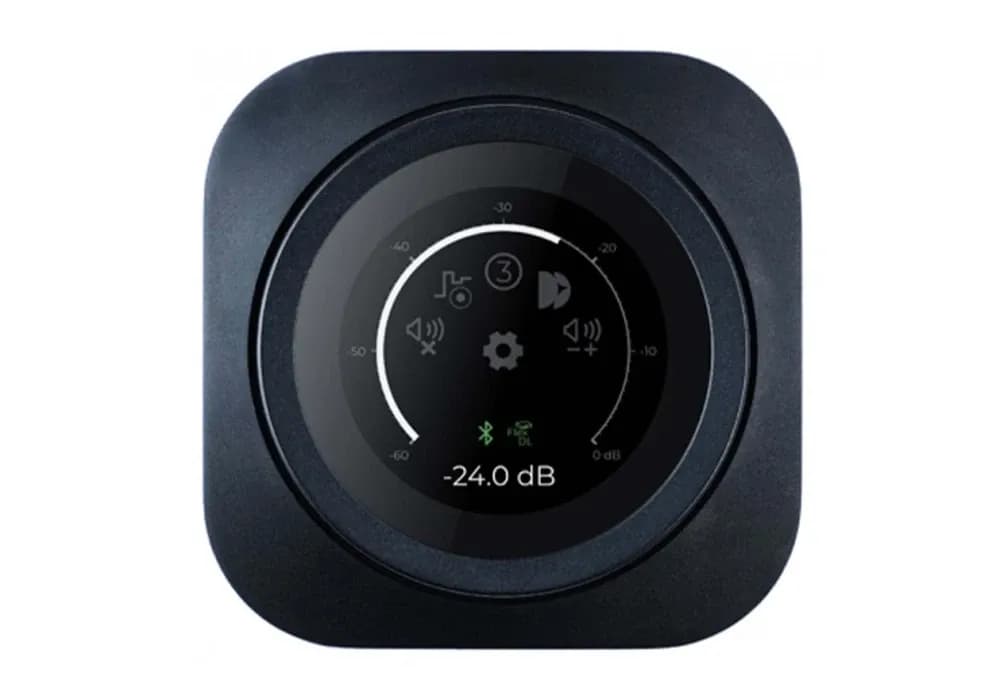
Ergonomically, the large rotary encoder and circular screen suggest that miniDSP leaned into muscle memory rather than touch-centric design trends. A physical encoder offers deterministic control over gain and menu navigation, avoiding the jitter and accidental inputs that plague glass interfaces. The round OLED, while limiting in terms of text density, aligns well with hierarchical menus and radial indicators—arguably a better fit for audio parameters than rectangular, information-heavy layouts. Taken together, the KD‑1 feels less like an accessory and more like an acknowledgment that DSP-heavy systems still benefit from a dedicated, purpose-built control surface.
HiFi Weekly Digest
New gear, best reads, and deals — every Friday.