Get the weekly hi-fi digest — new gear, best reads, and deals.

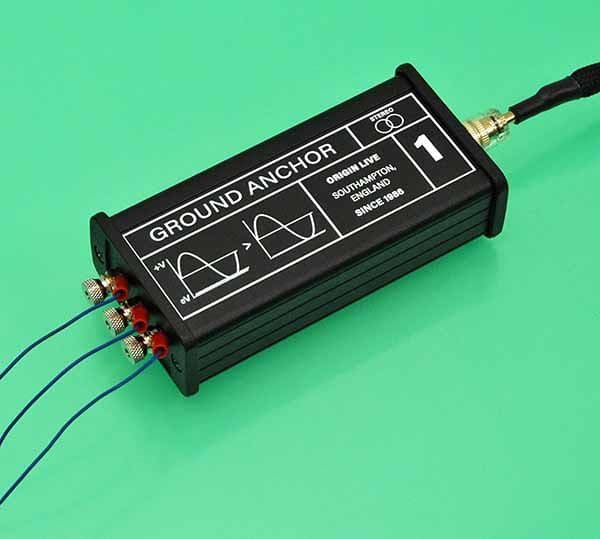
Origin Live launches Ground Anchor grounding box to reduce airborne, mains, system, and microphonic noise in vinyl playback chains between tonearm and phono preamp.
Developed with Puritan Audio Laboratories, the Ground Anchor reflects a by-ear design philosophy leveraging Puritan’s expertise in minimizing RF, EMI, and electrical noise.
Features three grounding posts accommodating Origin Live premium tonearm cables with multiple grounds, supporting varied phono preamp 0V reference schemes to reduce hum.
What sits beneath the Ground Anchor concept is less about adding yet another box and more about rethinking how a cartridge’s floating reference is treated once it leaves the arm pillar. Several sources converge on the idea that modern phono stages handle 0V differently—some bond signal ground to chassis early, others keep it quasi-floating until later in the gain stage. By externally managing that reference point, the Ground Anchor effectively becomes a controlled drain path for RF energy riding on the arm tube and cable shields, rather than letting it modulate the cartridge signal itself. This is particularly relevant with moving-coil systems, where sub‑millivolt outputs make any parasitic noise proportionally more destructive, and where thin, minimally shielded internal wiring leaves the arm structure doing most of the heavy lifting.

There’s also an interesting philosophical split between conventional star-grounding dogma and what Origin Live appears to be pursuing here. Instead of hard-tying everything to the phono preamp’s ground post, the box introduces a passive intermediary that can decouple noisy chassis references from the cartridge loop. Puritan’s influence shows in the emphasis on RF and EMI behavior rather than simple DC continuity—less about resistance figures, more about how high-frequency energy is encouraged to exit the system without creating new loops. In practice, this aligns with forum chatter around step-up transformers, where users often report that SUTs expose grounding inconsistencies more ruthlessly than active MC stages due to their wide bandwidth and susceptibility to airborne interference.
The more nuanced takeaway is that the Ground Anchor isn’t positioned as a universal “noise killer,” but as a way of normalizing grounding behavior across mismatched components. Systems mixing different arm manufacturers, aftermarket cables, and phono stages with idiosyncratic earth schemes are often where low-level hash and hum live on. By centralizing and controlling how those grounds reference 0V, the design aims to stabilize the electrical environment the cartridge sees—less grit in transients, more coherent spatial cues, and that oft-discussed sense of calm behind the music that tends to separate merely quiet vinyl rigs from genuinely sorted ones.
New gear, best reads, and deals — every Friday.

* Queen will release a 5CD+2LP super deluxe Queen II box set on 27 March 2026 via EMI, expanding the original 1974 album extensively.

* Audio Research I/55 is a compact tube integrated amplifier derived from I/70, succeeding I/50, targeting high-end listeners seeking classic tube sound with m…

* ToxFreeLife tested 81 headphone models from brands including Sony, Apple, JBL, Bose, Samsung, and Temu across European retail and online marketplaces.

* Audio-Technica launches the ATH-CKD7NC USB-C wired earphones on February 27, featuring hybrid noise cancelling and priced at ¥9,680 via direct sales.